

elements-set-of-natural-and-floral-elements-G9XCU6B.png

Poly-L-lactic Acid (PLLA) Fillers

Poly-L-lactic Acid, also known as PLLA fillers, has become a standout option thanks to its long-term facial-rejuvenation feature. While fillers in non-surgical aesthetic treatments usually focus only on volume, PLLA’s ability to restore one’s own collagen and skin tissue makes it a safer option than others.

In Turkey, the most attractive country for PLLA fillers, the cost for each syringe is approximately $150 to $450.

As a leading clinic for medical tourism in Turkey, we specialize in advanced biostimulators like PLLA, ensuring international safety standards.

In this article, we will discuss the properties of PLLA fillers used in dermal filler treatment, which parts of the body they can or cannot be applied to, and the treatment and recovery process.

Published by: Vantage Editors
Vantage editors consist of expert writers in the healthcare field, and our articles are reviewed and approved by our medical doctors.
Updated: April, 2026
poly-l lactic acid

What are poly-L lactic acid fillers?

With age, our face loses its volume of fat, muscle, skin and bone. Over time this leads to a lax & sunken appearance. At this stage, injectable dermal fillers based on poly-L-lactic acid restore that structure. PLLA is known as a biostimulating dermal filler, meaning that it stimulates your own tissue to produce new collagen. With time, your skin will break down PLLA into water and CO2.

In short, injectable polylactic acid is a synthetic substance that is biodegradable and biocompatible. It has been used for decades in dissolvable surgical stitches. But, unlike HA fillers, it works differently. Instead of making the skin instantly plump, PLLA helps to produce collagen.

Reach us to know your eligibility for PLLA filler

How is Poly-l-Lactic Acid Used in Facial Aesthetic Treatment?

masseter botox icon

Chin

Makes your face look more defined, improves your profile and supports your chin.

temples

Temples

It fixes the hollow look on the upper part of the face and makes the face look youthful.

mid-face icon

Mid-face

It makes the volume of your cheeks more even, and helps to reduce the appearance of wrinkles around your mouth by making the cheekbones firmer.

green icon for front of ears

In front of the ears

It makes your face look more even and balanced.

face icon yellow

Jawline

It makes your face look more defined and firm, and it helps reduce the appearance of jowls over time. The jawline is cleaned with antiseptic.

green icon for plla before after

Nasolabial Folds

It makes deep smile lines less noticeable over time.

PLLA Before & After Steps

A successful PLLA treatment depends on good pre- and post-treatment care. 

What should you do before the procedure?

  • Don’t take blood thinners like aspirin or ibuprofen 3–5 days before treatment. This will help to reduce bruising.
  • Stop using products with retinoid and strong exfoliants for at least 2 days before injection.
  • Make sure you drink enough water.
  • Let your insurance company know about any medical conditions or medications you have.

What to do after polylactic acid dermal filler?

  • Accelerate blood flow to the area by creating a daily massage routine. Massage for 5 minutes, 5 times a day, for 5 days.
  • Keep your head raised at night to reduce swelling.
  • Don’t do hard exercise or go into a hot place (like a sauna) for 2 days.
  • You might feel a bit of tenderness, see swelling or feel a firm bump under the skin, but don’t worry – this is normal.

Aftercare

What can I expect after having had PLLA?

You will see the results after 6 weeks to 2 months as new collagen starts to form. This effect is done bit by bit and looks quite natural. Therefore, your skin can feel softer, more elastic and fuller over time.

NOTE: Depending on your goals, you may need 2-3 sessions at 4-6 week intervals.

How long does poly-L lactic acid filler last?

According to the American Society for Dermatologic Surgery, poly-L-lactic fillers last up to 2 years, depending on the individual. A scientific article in the National Institutes of Health supports this term, stating that nearly half of the PLLA product can be digested within 6 months.

The total duration of treatment is usually between 1 and 2 years. In general, follow-up treatments are required to maintain the results.

ppla fillers

Consult Our Surgeons

Who is PPLA suitable for & Who is not?

PLLA fillers are not suitable for every body type and cannot be applied to every part of the face or body. For example, lips and areas close to the eyes are at risk for these fillers. Below you can find a table of who the treatment is suitable for and who it is not suitable for:

Ideal Candidates

PLLA fillers are ideal for such patients:

  • Individuals aged 30-60+ with moderate facial volume loss
  • People in good health with no active skin infections or autoimmune diseases
  • People seeking slow but long-lasting facial rejuvenation
  • Those seeking non-surgical options of areas such as the buttocks or arms
  • Those who are not looking for quick success, but rather a long-term change.
  • Patients with reasonable goals who are willing to commit to repeat treatments

Not Appropriate 

PLLA is not recommended for:

  • Thin skin areas (e.g. lips or tear troughs)
  • Who requires immediate correction
  • Patients with lupus or any other connective tissue disease
  • Autoimmune disease or previous history of keloids
  • Unregulated blood sugar levels
  • Patients who are allergic to any of the ingredients
  • Women during pregnancy or lactation
  • Not suitable for people with infected areas. If there is any infection on the skin, filler procedure should be postponed until it is treated.

What is the difference between PLLA and fillers?

PLLA (e.g., Sculptra) stimulates collagen, and the results can last for more than two years. You can have PLLA for the face, bottom, chest and arms. You can see the first results in 6 to 12 weeks. However, it can’t be reversed.

HA fillers such as Juverderm and Restylane add volume instantly. You can see the results within a few hours. It is shorter than PLLA, lasting between six months and a year. You can use it on the face, lips and under the eyes. It is possible to reverse this process, and hyaluronic acid fillers can be dissolved with hyaluronidase.

To sum it up, PLLA is best for people who prefer results that are natural and regenerative. On the other hand, HA is ideal for those wanting quick volume.

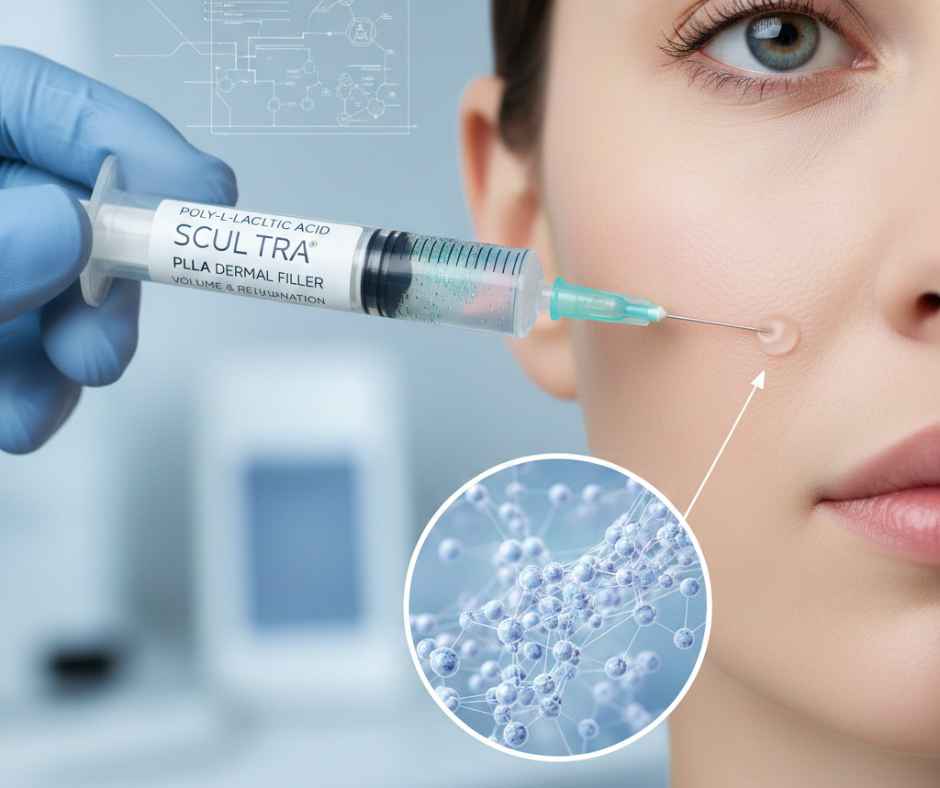
plla dermal filler syringe

The Table of Feature & Details of Poly-L-Lactic Acid Fillers

Feature

Details & Specifications

Treatment Type

Non-surgical bio-stimulatory injectable

Primary Goal

Natural collagen production & volume restoration

Target Areas

Nasolabial folds, chin wrinkles, hollow cheeks, and temples

Procedure Time

30 – 45 minutes

Anesthesia

Local anesthetic or numbing cream

Results Visibility

Gradual (optimal results after 4-6 weeks)

Longevity

Up to 24 months (2 years)

Recommended Sessions

Typically 2-3 sessions, 4-6 weeks apart

Recovery Period

Minimal (1-2 days of slight swelling or bruising)

PLLA vs. Hyaluronic Acid vs. Radiesse

1. PLLA (Poly-L-Lactic Acid)

  • Best For: Overall facial hollowing, deep skin folds, and long-term volume restoration.

  • How it Works: It is a bio-stimulator. Instead of physically filling the wrinkle, it triggers your body’s natural collagen production.

  • Results: Results are gradual (visible after 4-6 weeks) but very natural-looking.

  • Longevity: One of the longest-lasting options, with results remaining visible for up to 2 years.

  • Reversibility: Cannot be dissolved manually; it is naturally metabolized by your body over time.

2. Hyaluronic Acid (HA) Fillers

  • Best For: Fine lines, lip enhancement, and immediate hydration.

  • How it Works: It is a physical gel that binds to water molecules to provide instant volume.

  • Results: You see the final effect immediately after the injection.

  • Longevity: Typically lasts between 6 to 12 months.

  • Reversibility: Fully reversible using an enzyme called Hyaluronidase.

3. Radiesse (Calcium Hydroxylapatite)

  • Best For: Jawline contouring, hand rejuvenation, and deep wrinkles.

  • How it Works: It provides a dual action instant physical lift and long-term collagen stimulation.

  • Results: Provides immediate correction with improved skin quality over the following months.

  • Longevity: Generally lasts between 12 to 18 months.

Why Choose Istanbul for PLLA Treatments? 

More than just competitive pricing, opting for your Poly-L-Lactic Acid (PLLA) treatment in Istanbul provides access to first-class medical resources and top-tier specialists. At our clinic, we blend Turkish hospitality with global medical benchmarks.

  • Our doctors are experts in bio-stimulatory injectables, providing tailor-made, natural facial changes for all face shapes.
  • Vantage clinic is located in the heart of Istanbul and is easily accessible for international patients who are seeking top-quality non-surgical aesthetic methods.
  • We strictly adhere to global protocols for PLLA re-constitution and injection techniques, providing the highest quality of care to every patient.

Our Clinical Environment and Safety Standards

We put safety first. If you’re thinking of coming to us for hair restoration or high-end skin treatments like PLLA, you can be confident that we’re following all the medical standards to keep you safe and sound.

  • Our facilities have top-notch technology, so you can be sure that the environment for all injectable procedures is strictly sterile.
  • We only use top-quality, FDA-approved Poly-L-Lactic Acid products to make sure they’re biocompatible and will last.
  •  Every PLLA session starts with a detailed skin analysis. We don’t believe in a cookie-cutter approach; we tailor every treatment plan to your anatomy and goals.
  • We’ll give you post-op support, so all the info you need to get the best results and keep your collagen production going strong.

Frequently asked questions

Yes, certain choices can affect how long the effects of PLLA fillers last. For instance, smoking, alcoholism, pot, poor skin care, and excessive sun exposure can accelerate the breakdown of collagen on your skin. This may shorten the duration of the results. In contrast, a healthy living style, including the use of sun screen, proper skin care, and a nutritious diet, can help extend the benefits of PLLA treatments.

Yes, at Vantage Clinic we can combine PLLA fillers. For example, a common combination is PLLA with hyaluronic acid fillers. Microneedling, non-surgical rhinoplasty and laser therapy can also improve your skin by improving its texture, shape and tone. Based on your expectations, we can decide your sessions and treatments together. 

PLLA fillers like Sculptra® are made from biologically compatible synthetic materials that have been used for decades. Because they contain no animal or human components, the risk of allergic reactions is minimal. That’s why allergy testing is not usually required before treatment. 

According to the NIH, PLLA can have some complications. Examples of short-term side effects include oedema, pain, dyschromia, ecchymosis, overcorrection, localised cellulitis and embolism.

Polylactic acid (PLA) has important properties that give it a particular place in the field of medicine. For example, it is biocompatible and has a biodegradable nature. Because of this, it can be used safely in the body and breaks down naturally over time. However, like any filler, the injection of PLA dermal fillers also has some side effects. For example, the most common short-term effects are localized bruising and swelling, while long-term complications include nodules, subcutaneous papules, and granulomas.

The target of polylactic acid treatments is to make the skin firm and elastic. Polylactic acid improves the appearance of wrinkles by bringing volume to the skin. It makes the skin look younger and more oval, and balances skin tone.

  Citations

Get Free & Confidential Medical Consultation

100% confidential consultation with our medical experts