

Our experts explain scalp reduction surgery as an alternative treatment for pattern baldness and share their views on how scalp reduction procedure helps restore hair density and treat hair loss.
Lots of people think that being bald is a problem that affects only men. However, this is a myth. In fact, studies show that up to 52.2% of women suffer from serious hair shedding after menopause. This reality makes hair loss a truly universal concern, contributing significantly to the estimated 1.1 billion people worldwide living with androgenetic alopecia.
Specialists have developed numerous methods for treating baldness, ranging from FDA-approved medical therapies like Minoxidil and Finasteride to surgical interventions such as forehead reduction and FUE hair transplantation which now accounts for over 85% of all surgical hair restoration procedures worldwide. Driven by this technological evolution, the global hair restoration industry has expanded rapidly, with leading medical tourism destinations like Turkey alone welcoming approximately one million international patients annually, alongside established markets in the United States, the United Kingdom, Mexico, Thailand, and India.
Published by: Vantage Health Communications Team | Our Editorial & Clinical Standards
Updated: October 19, 2026
Medical Notice: This guide is educational, formulated using peer-reviewed dermatological literature, and does not replace an in-person clinical trichoscopy examination.
Only a surgeon who examines your scalp can say whether you qualify. Book a consultation to discuss your options, including non-surgical and transplant alternatives.

The surgeon removes sections of hairless scalp and draws the hair-bearing skin together to cover the area. It is a bit like patching a worn spot on a pair of jeans using fabric from the same pair.
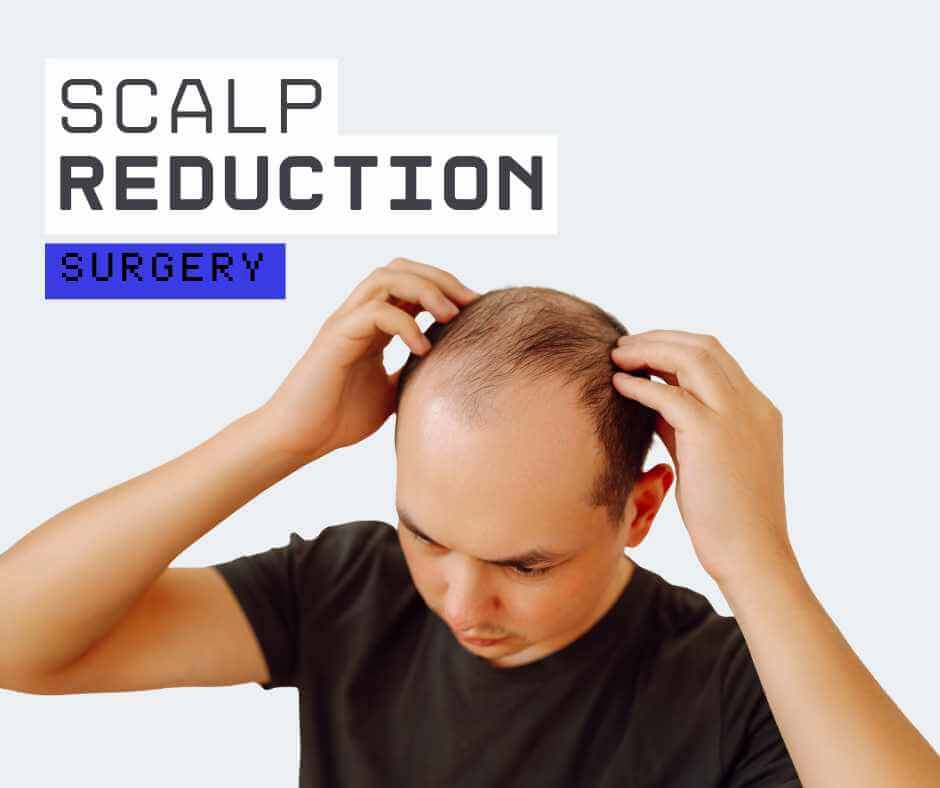

Scalp reduction helps restore areas of lost hair. During this surgical procedure, the surgeon removes sections of the bald scalp and stretches the surrounding areas with thick, healthy hair follicles to cover the lost hair region.
In simple terms, the surgeon takes away parts of the hairless scalp and pulls together the hair-covered scalp to fill in those areas. It’s a bit like patching a worn spot on your favorite jeans with a piece of fabric from the same pair.
The assessment and planning take about 20 to 30 minutes. The whole anaesthesia process should take 15-20 minutes, give or take. Marking your scalp takes about 10 minutes, and the incision generally takes a little longer and can take up to an hour. The whole scalp flap procedure takes about half an hour, and closure usually takes 30 to 50 minutes. Applying a sterile dressing and giving the patient post-op instructions also takes a maximum of 15 minutes. So, it’ll take between two and three and a half hours.
Stage | Approximate time |
Assessment and planning | 20 to 30 minutes |
Anaesthesia | 15 to 20 minutes |
Marking | About 10 minutes |
Incision | Up to 1 hour |
Flap mobilisation | About 30 minutes |
Closure | 30 to 50 minutes |
Dressing and instructions | Up to 15 minutes |
Total | About 2 to 3.5 hours |
Times vary with the size of the area and the complexity of the case.
All scalp reductions result in a permanent scar, but it is usually easy to camouflage beneath neighboring hair.
Visibility comes down to individual healing, wound tension, and future hair loss. Over time, tissue tension can cause the scar to widen slightly (stretch-back), or progressive balding can unmask the incision line. If the scar becomes noticeable, corrective treatments like hair transplantation directly into the scar or surgical scar revision can restore natural concealment.
Hair cannot sprout directly from scar tissue because scars lack follicles. However, hair in the surrounding scalp will grow back completely.
Surgery can cause nearby follicles to shed temporarily due to local tissue stress (shock loss), but this resolves on its own within a few months. If you wish to conceal the thin incision line entirely, techniques like trichophytic closure or secondary hair grafting into the healed scar can restore coverage right over the seam.
Pricing
The cost of scalp reduction surgery varies a lot by country. It starts at $7,000 in the US clinics, while in Turkey it’s half that price. Since Vantage Clinic is a Turkish clinic, we compared our prices with our competitors in Turkey. The cheapest scalp reduction surgery in Turkey costs around $2,800. In Istanbul, the average price at a clinic is around $3,600.
At Vantage Clinic, the cost of this procedure varies according to the packages, but starts at an average of $3,500. We may be able to offer you much more affordable prices depending on your scalp size, hair loss condition, and needs. Contact us now for a detailed analysis and quote!
Scalp Reduction Surgery Cost at Vantage Clinic in Istanbul, Turkey

Starting From $3500
Costs vary greatly by country and by the extent of the operation.
Location | Approximate Starting Price |
United States | From ~$7,500 |
United Kingdom | From ~£5,000 ($6,400) |
Turkey (Entry-level / Basic) | From ~$2,800 |
Istanbul (Accredited Surgical Centers) | From ~$3,500 |
Estimates are based on average prices reported on platforms like RealSelf. Your final quote depends on the size of the bald area, your scalp elasticity, anesthesia type, and whether you combine it with a hair transplant.
What affects the price: the size of the area to be removed, the surgical technique, the type of anaesthesia, hospital stay and whether the package includes accommodation, transfers and follow-up. Ask what is included before comparing quotes.
Recovery from scalp reduction is longer than recovery from FUE transplant. The surgeon closes the scalp tightly; therefore, the skin and underlying tissue need time to settle into place. How long this takes depends on how much tissue was removed and how elastic your scalp is.
Postoperative monitoring is essential after scalp reduction. As emphasized in standard surgical hair restoration literature (e.g., Unger et al.), prompt contact with your clinic is required if you observe signs of compromised blood supply such as skin turning dark or pale, rapidly expanding scalp swelling, or localized fever and drainage.
Bald scalp excision may carry certain risks and long-term effects. For example, as with other surgeries, if you engage in intense physical activity, your stitches may be prone to bleeding, so it is more sensible to do lighter exercise for the first few weeks.
To prevent increased bleeding, avoid blood-thinning foods, beverages, and medications for the first few days. Pot and alcohol, in particular, can accelerate blood flow and lead to bleeding.
Below, you can find the common risks of scalp flap surgeries:
In case of any complications, corrective procedures may be necessary after healing, but these are generally less invasive and intensive than the initial surgery.
Additionally, the American Society of Plastic Surgeons states that your hair may fall out for approximately 6 weeks after surgery. This is similar to the sudden hair loss seen after hair transplant techniques. After that, it may take another 6 weeks for new hair to grow.
Sure. Vantage Clinic no longer prefers painful procedures such as scalp lifting surgery. Thanks to our young and dynamic team and advanced technology, we apply the most trending baldness therapies of 2025-2026, such as DHI and UFUE, which minimize damage to your scalp.
Scalp reduction removes bald areas and stretches nearby hairy skin to cover them. It is best for a small, well-defined bald crown or top. It is more surgical and invasive; requires stitches. The worst part of this surgery is scarring.
Hair transplant moves individual follicles from donor to bald areas. It’s best for most types of female and male pattern baldness, today they are gold-standard modern treatment. Especially FUE, hair replacements are minimally invasive but depending on the method, there might be minimal scars. Modern hair restoration treatments are becoming ever more popular because they are much less invasive, have a shorter recovery time, produce better results and carry fewer risks than scalp reduction.
The name most suspected of having undergone scalp reduction surgery is Donald Trump. According to some clinics, Trump’s scalp reduction dates back to 2019. There are some noticeable changes in head shape and hair density between images from 2019 and 2025. However, Trump has been hiding his hair loss for years by using a messy hairstyle. Therefore, probably, there is no link between Donald Trump and scalp reduction.
Although it has never been confirmed, many fans speculate that her hairline has receded based on early modeling photos. However, the famous figure may have also undergone hairline lowering surgery.
Although Tom Hanks is known to be someone who avoids cosmetic procedures such as Botox, dermal fillers, and hair transplants, there are those who believe he had such surgery to stabilize his hair loss.
Yes, because it is an old technique and there are few experienced surgeons in this field, poor outcomes are common.
This surgery will not make your head smaller, but we can conceal the bald areas on your head.
This method is generally no longer used for baldness treatment. It is preferred to conceal some scalp scars like alopecia scars.
Donor Area Scar Revision After Hair Transplant — A clear breakdown of procedures, options, and what to expect during your scar correction transformation.
Scalp Surgeries — Essential details and factors influencing your comprehensive hair and scalp surgical options.
Scalp Micropigmentation in Turkey — Explore non-surgical options and techniques to conceal scars and enhance your aesthetic goals.
100% confidential consultation with our medical experts
WhatsApp us