
elements-set-of-natural-and-floral-elements-G9XCU6B.png

PMMA Fillers

Polymethylmethacrylate (PMMA) fillers are a type of long-lasting cosmetic injection that adds volume to the skin. They consist of tiny, plastic-like beads (known as microspheres) that are around 30–50 micrometres in size and are mixed into a collagen gel.

When injected, the collagen provides an immediate filling effect. Over time, your body builds its own collagen around the tiny beads, which helps to keep the area full and firm for an extended period.

Facial filler – PMMA prices in Turkey based on 1 ml are as follows:

  • Between 4,000 and 12,000 TL ($100 to $300) for permanent methacrylate fillers, e.g. Bellafill. The effect lasts for at least 5 years or more because it creates its own collagen around the microbeads. 
  • For semi-permanent fillers (such as Sculptra and Ellanse), prices range from 1,000 to 3,000 TL, with a longevity of 1-2 years.
Published by: Vantage Editors
Vantage editors consist of expert writers in the healthcare field, and our articles are reviewed and approved by our medical doctors.
Updated: February 2, 2026
pmma dermal filler definition

What are PMMA dermal fillers?

PMMA (polymethylmethacrylate) fillers are semi-permanent to permanent dermal fillers consisting of tiny PMMA microspheres suspended in collagen gel. Unlike temporary fillers, the body does not absorb the PMMA microspheres, which stimulate ongoing neocollagenesis (new collagen formation). The result is that the fillers last much longer. Bellafill (formerly known as Artefill) is the only PMMA product that has FDA approval for use on nasolabial folds and acne scars.

Continue read to learn how PMMA (polymethyl methacrylate) fillers -for example; ArteFill® and Bellafill®– combine 20% PMMA microspheres in bovine collagen for medium-to-deep wrinkle correction, durability up to five years, and safety considerations like granuloma risk.

Reach us to know your eligibility

Which areas of the face are suitable for PMMA treatment?

masseter botox icon

Chin Augmentation

To enhance the chin, specialists inject PMMA deep into the midline using a retrograde technique to avoid the submental artery branches. Therefore, this creates projection and a more balanced facial profile.


temples

Temple Hollowing

In the temporal region, doctors inject PMMA into the hollow as a single depot, positioning it in the sub-SMAS plane just beneath the superficial layer of the deep temporal fascia. Correct placement in the anatomical plane is crucial to prevent vascular complications.

mid-face icon

Midface Volume Restoration

The cheekbones, under-eye area, upper jawbone, and cheeks are included in this region. Typically, practitioners use a blunt cannula technique to inject PMMA in the deep subcutaneous plane, thereby restoring volume while lowering the risk of vascular injury.

face icon yellow

Pre-jowl Sulcus & Jawline

Doctors use fanning or cross-hatching techniques to carefully place PMMA in the subdermal / subcutaneous layer along the jawline, while avoiding the facial artery and filling in depressed areas to create a smoothed-out contour.


Key Characteristics of PMMA Injections

Here are the characteristics of poly(methyl methacrylate) fillers:

  1. What’s inside?: Ingredients of PMMA fillers are pmma microspheres and a collagen or gel carrier.
  2. What is its form like?: Non-resorbable, smooth, and round particles.
  3. What are the sizes?: ~30–50 µm
  4. How long does it last?: Semi-permanent to permanent; effects last 5–10 years.
  5. How does it work?: The PMMA spheres act as a scaffold for collagen production, thus increasing volume gradually.
  6. What is the density of PMMA fillers?: The density of PMMA fillers is approximately 1.18–1.20 g/cm³. It is slightly denser than water and has a density between that of olive oil and milk.

What do clinic studies say about PMMA?

Well-structured clinical studies prove the long-term effectiveness and safety of PMMA filling materials.

  •  In a 12-month midface study, 100% of patients showed noticeable improvement after three months, and 91.3% maintained the results after 12 months.
  • In jawline augmentation, patients reported improvement at every follow-up, with results lasting up to 104 weeks (two years).
  • In a five-year nasolabial fold study, 84% of patients were either satisfied or very satisfied at the end of the study period.

These results show that when given correctly, PMMA can last a long time and is generally well-tolerated, reducing the chance of negative side effects.

How Do PMMA Fillers Act?

PMMA injections work through a dual-action mechanism that provides both immediate and long-lasting results. You will see the immediate volumizing effect right after your PMMA procedure. 80% of PMMA consists of collagen gel, so it adds volume and smooths out wrinkles or acne scars. The gel is reabsorbed by the body over several months, while long-term tissue stimulation continues. Unlike temporary fillers, PMMA remains permanently in the tissue and acts as a scaffold that stimulates fibroblasts to produce natural collagen around the microspheres. In 3 to 6 months, this new collagen growth improves skin texture, stabilizes the contour of the treated area, and sustains volume. The good news is that once encapsulated by your body’s own collagen, it remains stable for at least 5 to 10–12 years.

Advantages of PMMAs

  • High stability, long-term support and permanent soft tissue filler

  • Shape retention, non‑degradable Immediate volume restoration + collagen regeneration

  • Controlled particle size for smooth injection

  • FDA‑approved use for nasolabial folds, deep wrinkles, atrophic scars

  • GMP production & quality control ensuring safety and consistency

Risks of PMMA injections

  • Temporary swelling, bruising, and redness
  • Transient small nodules or lumpiness (typically resolving without intervention)
  • Potential for delayed inflammatory reactions
  • No granulomas as a PMMA side effect were reported in a 24-month jawline study.
  • In a larger 5-year study with 1008 patients, the granuloma rate was 1.7%.
  • Most adverse events were minor and transient

How are PMMA microspheres manufactured to avoid complications?

Polymethyl methacrylate-based fillers are designed to reduce complications by preventing migration and immune reactions thanks to their smooth, uniform microspheres. This biocompatible, non-toxic material is suspended in a collagen gel to allow for gradual and natural integration.

Aftercare

PMMA Aftercare

PMMA filler aftercare steps and points to note are as follows:

  • In the first 24 to 48 hours, expect some redness, swelling, and tenderness at the injection area — these are pretty normal and can subside within 3 to 7 days.
  • You can expect mild bruising, too; it may last up to a maximum of 10 days.
  • You can apply cold compresses to reduce swelling, 10 minutes on and 10 minutes off.
  • Sleep with your head elevated for the first night to reduce swelling on your face.
  • Keep the treated area clean using gentle, non-abrasive cleansers.
  • Please do not consume alcohol or blood-thinners for the first 48 hours, and do not wear makeup for 12 hours after the PMMA medical procedure.
  • Apply broad-spectrum SPF 30+ sunscreen to treated areas daily.

Note:

PMMA soft tissue fillers settlement will be visible right after the application, and full results will develop gradually over 1–3 months. Please note: PMMAs require 2–3 treatment sessions spaced 4–6 weeks apart for optimal results.

PMMA filler application

Can PMMA fillers be removed?

No, PMMA fillers cannot be removed with enzymatic dissolvers like hyaluronic acid dermal fillers can. If overcorrection, granulomas, or nodules occur, surgical excision may be attempted, but complete removal without tissue damage is not guaranteed.

Can you eat after the procedure?

Yes, immediately, but avoid alcohol for 24 hours. During the first few days, it is beneficial to stay away from caffeine and focus on consuming plenty of fluids and fruits.

Does it cause jowls?

No, though temporary facial asymmetry is possible. During the first five years when PMMA is most effective, it is expected to significantly prevent sagging in the jaw area.


Consult Our Surgeons

PMMA Filler Before-After Effects

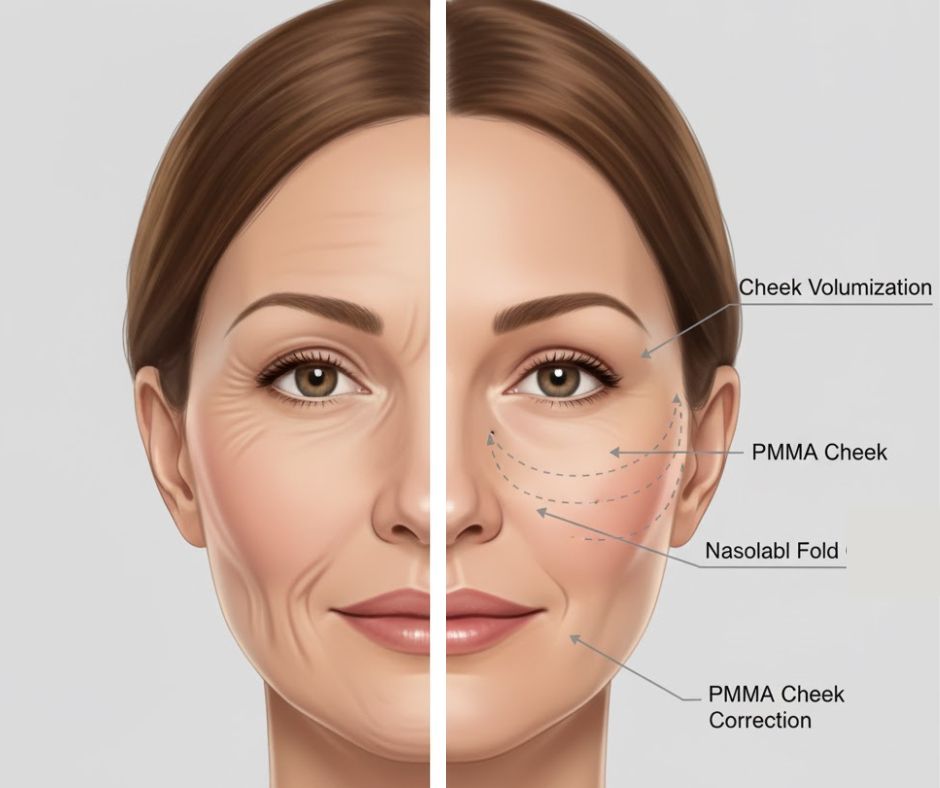
PMMA semi-permanent fillers produce immediate results. In fact, the immediate plumping effect and smoother appearance are due to the collagen gel, but swelling and bruising are to be expected. In the long term, PMMA stimulates fibroblasts to produce new, natural collagen. For this reason, PMMA fillers create a natural-looking rejuvenated appearance. Unlike other permanent fillers, they do not freeze facial expressions or create an unnatural appearance. They do not enlarge facial contours; they simply stimulate natural collagen production. Of course, no surgical procedure can match the realism of your natural look, but temporary fillers can come closest. Discuss the suitability of the treatment with your doctor.

pmma filler before and after illustration on a woman's face that shows cheek volumization, PMMA cheek, nasolabl folds, and PMMA cheek correction.

Who is PMMA suitable for & Who is not?

Permanent fillers are suitable for healthy adults who are looking for a long-lasting solution to specific aesthetic concerns.

Ideal Candidates

PMMA fillers are ideal for:

  • People with deep wrinkles or folds, including nasolabial folds (smile or laugh lines), marionette lines (mouth-to-chin lines or low-face wrinkles) and midface volume loss.
  • Those with atrophic acne scars who are looking for permanent, stable results.
  • Those who want to avoid frequent touch-ups and who have stable, healthy skin with no active acne or skin inflammation.
  • Non-smokers or those with a good ability to heal wounds.
  • Adults aged 21 or over.

Not Appropriate 

It is not recommended for:

  • People with allergies to bovine collagen or lidocaine, which are often used as carrier ingredients in PMMA fillers.
  • Individuals with autoimmune disorders or chronic inflammatory conditions
    (e.g. lupus or rheumatoid arthritis), or who have active skin infections, acne or open wounds.
  • Individuals with body dysmorphic disorder.
  • Pregnant or breastfeeding women 
  • People under the age of 21.

PMMA Fillers vs. Other Types of Filler

Hyaluronic Acid fillers such as Juvederm and Restylane provide immediate volume and hydration, typically lasting between six and 18 months. One major advantage of HA fillers is that they can be dissolved using an enzyme called hyaluronidase if necessary, which makes them a flexible and safer option for first-time patients.

PMMA fillers, on the other hand, cannot be reversed once injected. These fillers are therefore better suited to experienced patients. PMMA fillers are most commonly used to treat deep facial wrinkles, such as nasolabial folds, or long-standing acne scars where longer-lasting results are desired.

Although filler with PMMA is effective, there is a risk of nodules, granulomas or infection if it is not injected by an experienced medical professional. 

A further key difference is the speed at which results are seen. While HA and calcium hydroxylapatite (CaHA) fillers provide immediate volume after injection, PMMA fillers offer instant correction from the collagen gel combined with gradual improvement over months as collagen builds around the microspheres. Poly-L-lactic acid (PLLA) fillers, such as Sculptra, also stimulate collagen production, but usually require multiple sessions and produce results more gradually than PMMA fillers.

Frequently asked questions

Yes, there’s mild downtime after PMMA treatment. As a permanent filler used for pitted acne scar treatment and medium-to-deep wrinkle correction, it may cause temporary swelling or bruising that resolves within 3-4 days.

Yes, third-generation PMMA fillers with improved microsphere size uniformity and a collagen gel matrix are suitable for first-time patients seeking long-lasting wrinkle correction.

Results appear natural, with smooth skin texture and lasting wrinkle reduction that maintains facial movement.

The most well-known PMMA filler in the US is Bellafill (previously known as Artefill), manufactured by Suneva Medical. It is FDA-approved for:

  • Correction of nasolabial folds (smile lines)
  • Treatment of moderate to severe atrophic facial acne scars on the cheeks

Yes, they are more cost-efficient long-term fillers because they provide permanent volume while reducing the need of frequent touch-ups.

PMMA treatment are most effectively injected in small, slow doses, either just under the skin or above the bone, depending on the area. Techniques such as threading, tiny droplet injections or a fan-like pattern help to spread the filler evenly, delivering smooth & natural results. Many doctors also prefer to use a blunt-tipped cannula rather than a needle, as this reduces the risk of bruising or other complications, which is particularly important in delicate areas such as around the eyes or mouth.

Yes, doctors can use PMMA fillers on the buttocks. The aim is to increase their volume and improve their shape for people seeking a minimally invasive procedure. While it does not provide the same impressive results as a Brazilian Butt Lift, but it is ideal for those who want a more subtle change. Please keep in mind that the use of PMMA in the buttocks is usually off-label. PMMA microspheres are injected into a collagen matrix using a fine needle or cannula, and the procedure generally takes around one hour.

  Citations

Get Free & Confidential Medical Consultation

100% confidential consultation with our medical experts