

Comprehensive Guide to Donor Scar Revision & Scalp Healing
Visible scars in the donor area right after a hair restoration procedure can undermine even the famous hair transplant results. With donor area scalp scar revision, hair transplant patients can tackle widened FUT linear scars, patchy FUE openings, post-necrotic tissue, or scarred scalp zones. The best way to treat them is a combination of donor scar repair procedure, scar excision with grafting, micropigmentation, and trichophytic closure techniques.
At Vantage Hair Clinic, our approach blends artistry with surgical precision. Contact us to learn about your treatment options and package prices for FUE or FUT scar revisions.
Published by: Vantage Editors
Updated: Sep, 2026

What Causes Hair Transplant Scars?
Not every hair transplant surgery is successful. Although some academic and medical sources indicate a success rate of 97-98%, unsuccessful hair transplant surgeries are also quite possible. When things don’t go as planned after a restoration, patients often search for “Why scars and necrosis occur after hair restoration?” or “Why do hair transplants leave scars?”. The chances of success in hair transplants vary depending on the type. FUT is the riskiest and oldest method, while FUE is the least risky.
Among the common reasons of HT scarring are infection (poor asepsis), poor surgical technique – such as excessive tissue handling, blunt dissection damaging subcutaneous plexus, incorrect punch depth in FUE, and high follicular transection rates – tight sutures, suboptimal layered closure, and patient biology (scar tendency, older age, or scalp laxity paradoxes).
Strip (linear) scarring occurs after FUT hair restorations. It is because of a linear elliptical donor incision in the occipital scalp. Visibility and width of the linear scar depend on strip width, the amount of tissue removed, closure under tension, how the dermis is approximated (suture technique), and the use or not of trichophytic closure (an edge-trim technique). Wider strips, excessive tension, poor closure, and poor wound healing produce widened linear scars. On the contrary, trichophytic closure decreases visible scar thickness.
Follicular unit extraction scars consist of many small and circular epidermal or dermal defects created by punches. When performed correctly FUE scars usually heal as tiny hypopigmented pinpoint scars; however, visible FUE scarring such as moth-eaten appearance, perifollicular fibrosis, cobblestoning, or wider punched islands arises from over-harvesting, large punch diameters, excessive transection of follicles, infection, keloid tendency, or prolonged instrumentation causing dermal damage. Over-harvesting can produce areas of decreased hair density and visible scarring patterning.

When do scars appear?
Immediately after the procedure, punctate scars are visible with modern techniques such as FUE, while horizontal scars are visible with older techniques such as FUT. However, these scalp scars should begin to disappear within 2-3 weeks as the skin regenerates in the FUE donor area. In the recipient area, scabbing should occur within the first 14 days, with significant improvement within 1 month.
In older techniques like FUT, the suture line in the donor area should heal noticeably within 2-3 weeks. If the color of the strip does not fade within one month after FUT hair transplant, you may suspect a risk of permanent scarring.
What are the stages of wound healing after hair transplant?
After any dermal injury the wound healing cascade activates:
Hemostasis → inflammation → proliferation (fibroblast collagen deposition, angiogenesis) → remodeling.
If the inflammatory phase lasts too long or gets too intense because of infection, injury, smoking, or poor blood flow, the healing process can get out of balance. Then, the fibroblast cells produce too much collagen, and the myofibroblast contraction can make the scar thick and raised, forming hypertrophic scars or keloids.
On the scalp, this can look like raised or widened scar tissue and changes in hair direction, known as cicatricial changes. A person’s genes, age and skin type can all play a part in whether or not they’re likely to get these scars.
Below you can find the healing process of scars by month and when to be concerned:
Month 1: Scars 1 month after hair transplant
We expect scabbing on the incision sites during the first 14 days after hair transplantation. Regardless of the technique used—whether you opt for an unshaven hair transplant or the oldest techniques—if there are no signs of noticeable scabbing, flaking, or scab shedding on the incisions between the first 14 and 21 days, you may begin to suspect something is wrong.
In the image beside, you can clearly see the difference between FUT-type scars and FUE-type scars.

What symptoms after 1 month should I see my doctor for?
Widened, depressed, or hypertrophic linear scar (FUT) or moth-eaten donor area with patchy thinning (FUE). If you notice these symptoms, and if the scar has not faded after about 30 days, or if the wounds are still open and red, you should consult your surgeon.
Month 2: Scarring 2 months after hair transplant
The second month of a classic hair transplant is when the donor and transplanted areas heal. Those with very sensitive skin may still experience some redness and skin sensitivity, but there will be no scarring. The transplanted hair grafts may also enter the shedding phase and fall out, which is normal.
What to Expect at 60 Days:
- No open wounds or crusts
- Minimal or no redness
- Soft, flat skin texture without raised scars
- Early hair regrowth may begin in some areas
When to See a Doctor:
- Persistent redness, swelling, pain or any signs of necrosis
- Hard, raised, or widened scars
- Pus, discharge, or foul odor
- Numbness that doesn’t improve
Month 3: Final condition of scarring at 3 months
By the third month, the donor area will have regained its original appearance. There may be slight hair thinning in the donor area. This does not mean overharvesting. If it still persists after the first 6 months, you should suspect overharvesting. In the transplanted area, you should now be starting to see hair growth.
What to Expect at 90 Days:
- No visible wounds or scabs
- Redness mostly resolved
- Early, soft new hairs appearing
- Natural scalp texture restored
When to See a Doctor:
- No hair regrowth at all in the recipient area
- Persistent or worsening redness, pain, or swelling
- Thickened, raised, or stretched scars
- Unusual numbness or tingling that hasn’t improved
Month 6: Will scarring occur 6 months later?
At six months, most healing is complete and the growth phase is well underway. About 50–70% of the hairs that have been transplanted have started to grow. The new hairs are still thin and soft, but they gradually get thicker over the following months. The donor area should look completely normal.
What symptoms should not be present in the 6th month?
Persistent erythema, induration, discharge, or delayed healing suggest infection or excessive inflammation.
Month 9: Can I treat scarring 9 months later?
By the 9th month, you should have seen a significant result from the treatment. If, despite reaching the 9th month, you still experience sparse or uneven hair growth, noticeable thinning in transplanted areas, persistent redness, bumps, or irritation, pain, numbness, or scarring that hasn’t improved, your surgery may have been unsuccessful.
1 Year Later: Is scar revision possible 1 year after hair transplant?
We expect noticeable changes after one year in all hair transplant treatments regardless of your surgery type, whether DHI, FUE, U-FUE, and FUT. The developments we expect are overall hair density, new hair strands in bald areas, and improvements in hair texture. Noticeable scarring, uncovered bald areas, or damage to the donor area are situations that may lead you to scalp scar revision surgery or a 2nd procedure.
Pricing
Hair transplant scar revision cost in Turkey
Scar revision for hair transplants in Turkey varies depending on the technique used and the number of grafts implanted. It can cost between $1,400 and $3,500 on average. For example, Turkish clinics that charge based on a fixed number of grafts offer donor area scar revision surgery packages starting at $1,400.
The package may include the following services:
- scar revision surgery,
- post-operative equipment,
- painkillers,
- bandanas and initial wash kits,
- accommodation, transportation, and personal assistant.
Hair Transplant Scar Revision Cost at Vantage Clinic in Istanbul, Turkey

Starting From $1400
Advanced
Techniques in Donor Scar Revision (FUT & FUE)
Scars resulting from hair transplantation can cause aesthetic concerns, especially for those who prefer short hairstyles like buzzcut. However, today there are various effective methods available to conceal or correct these scars. Turkey is a globally preferred center for hair transplant scar repair, with clinics specializing in this field.
In hair transplants performed using the FUT (Follicular Unit Transplantation) method, a strip of tissue is taken from the donor area and sutured to close the area. This procedure may leave a thin scar over time. FUE (Follicular Unit Extraction), on the other hand, is a method in which individual hair follicles are extracted and generally leaves less scarring.
Scar Revision Techniques:
1. Trichophytic or Beveled Closure: In FUT strip harvests, the wound edges are cut at an angle (bevelled) so that hair grows through the scar line, helping to hide it.
2. FUE Hair Transplantation: Individual hair follicles are transplanted into scarred areas to camouflage the scars. When it comes to FUE donor sites, using very small diameter punches (0.6-1.0 mm) causes less trauma, faster healing and less visible scarring.
3. Laser or Dermabrasion: The surface of the scars can be smoothed to achieve a more even appearance.
Best Clinic for Hair Transplant Donor Scar Revision in Istanbul, Turkey

Learn your eligibility for a donor scar revision
How are hair transplant scars treated?
No one wants to deal with scars when trying to treat baldness. However, as with any surgery, hair transplantation also carries certain risks like post-surgical scars. Donor area scar revision surgery is the first choice for patients seeking to get rid of hair transplant scars. Doctors generally recommend scar revisions as the safest and fastest solution.
Micropigmentation and Grafting for Seamless Scalp Repair
In scalp micropigmentation – SMP, special pigments are applied to the scalp to create the appearance of hair. This technique is an effective scar camouflage method, particularly for individuals with short hair.
On the other hand, in scar camouflage with hair transplantation, hair follicles harvested using the FUE method are transplanted into scarred areas to reduce the visibility of scars.
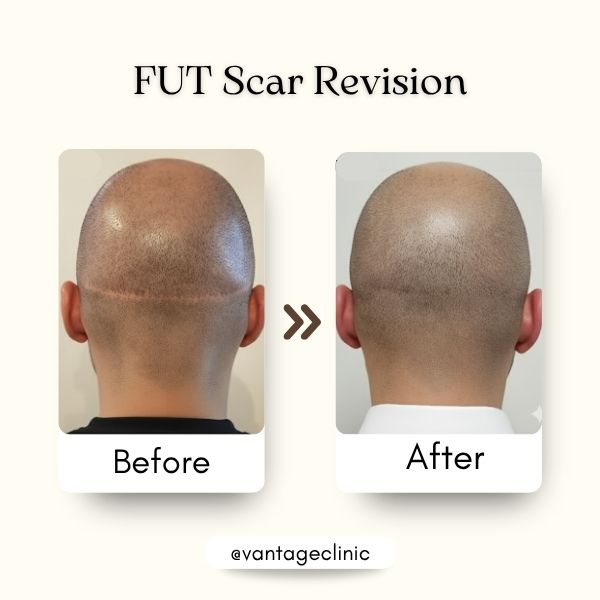
Donor area scar revision before & after photos


How to hide FUE scars?
If it has not yet been a year since your hair transplant for donor area scar revision, or if you do not feel ready for surgery at this time for various reasons, you can use nonsurgical FUE scar hiding methods for a temporary period. Here are many non-surgical methods, cosmetic hacks, and techniques available to conceal FUE scars:
1. Hair Styling Techniques
You can make tiny FUE scars less visible by growing your hair slightly longer or adjusting the parting. This works best when the scars are small and there’s a lot of hair around them. If you’re looking to hide FUE scars, the best hair-styling techniques include side parting, comb-overs, textured layers and slight hair lengthening to naturally cover the donor area.
2. Topical Camouflage Products
Colored powders, sprays, or fibers can temporarily mask scars, especially for short hairstyles.
3. Hair Fibers or Concealers
Keratin-based fibers adhere to existing hair, blending scars with surrounding hair for a fuller look.
FAQs
If you prefer to have extra grafts added for transplanted or donor area scar revision, yes, hair can grow back over the scar. However, this is a difficult procedure, and we advise you not to expect results as successful as those of a hair transplant surgery.
FUE donor area scars are point-like. They only cause a localized reduction in hair density and do not look like a wound. Therefore, they are not as noticeable or bothersome as FUT scars. Generally, patients who opt for donor area scar revision surgery are those who have linear scars from older techniques.
Scalp ischemic necrosis is basically when there’s a lack of blood supply to an area of the scalp. For example, if your doctor implants too many grafts too densely in one go, it can lead to focal ischemia. Also, if they damage the blood vessels during harvesting or flap/closure, or if they put too much tension on it after large FUT strips or overly tight closure, it can stop the blood from getting to the edges of the wound and cause the tissue to die.
There are a few things that can affect blood flow to your organs and tissues. These include smoking, not controlling diabetes, peripheral vascular disease, vasculopathies, using certain medicines that make your blood vessels narrow, and not drinking enough water. These things can increase the risk of necrosis in any surgery that involves the skin.
It is a gentle HT procedure but it may leave a point-like scar at the back of the head (donor area for hair transplant) if the extraction is not done properly.
In the shaved hair transplant method, the transplanted area is small. Therefore, scarring takes up less space in the transplanted area. However, as with the FUE method, scarring may occur in the donor area. The main risk of the UFUE method is bacteria and necrosis caused by moisture and dirt from the hairy scalp.
Citations
- Kerure, A. S., & Patwardhan, N. (2018). Complications in hair transplantation. Journal of Cutaneous and Aesthetic Surgery, 11(3), 147–152.
- Nirmal, B. (2013). A study of donor area in follicular unit hair transplantation. Journal of Cutaneous and Aesthetic Surgery, 6(1), 1–6.
- Sharma, R., & Avram, M. R. (2019). Follicular unit extraction hair transplant. Journal of Cutaneous and Aesthetic Surgery, 12(1), 1–7.
- Chen, J., & Zhang, Y. (2024). Recipient site scalp necrosis: A rare postoperative complication of hair transplantation. Journal of Cosmetic Dermatology, 23(4), 1234–1239.
- Alhamzawi, N. K. (2020). Keloid scars arising after follicular unit extraction hair transplantation. Journal of Cutaneous and Aesthetic Surgery, 13(3), 237–239.
- Chumak, V. (2023). Scalp necrosis after a hair transplant: A case study. Hair Transplant Forum International, 24(2), 58–60.
Related Articles
Hair Transplant Turkey GuideDiscover the latest hair transplant techniques offered in Turkey, including FUE, DHI, and unshaven FUE methods.
Low-Level Laser BenefitsExplore the benefits of low-level laser therapy (LLLT) in promoting hair regrowth and enhancing follicle health.
PRP Hair Therapy ResultsLearn about Platelet-Rich Plasma (PRP) therapy as a non-surgical option to stimulate hair growth and improve scalp health.

Get Free Medical Consultation
100% confidential consultation with our medical experts